
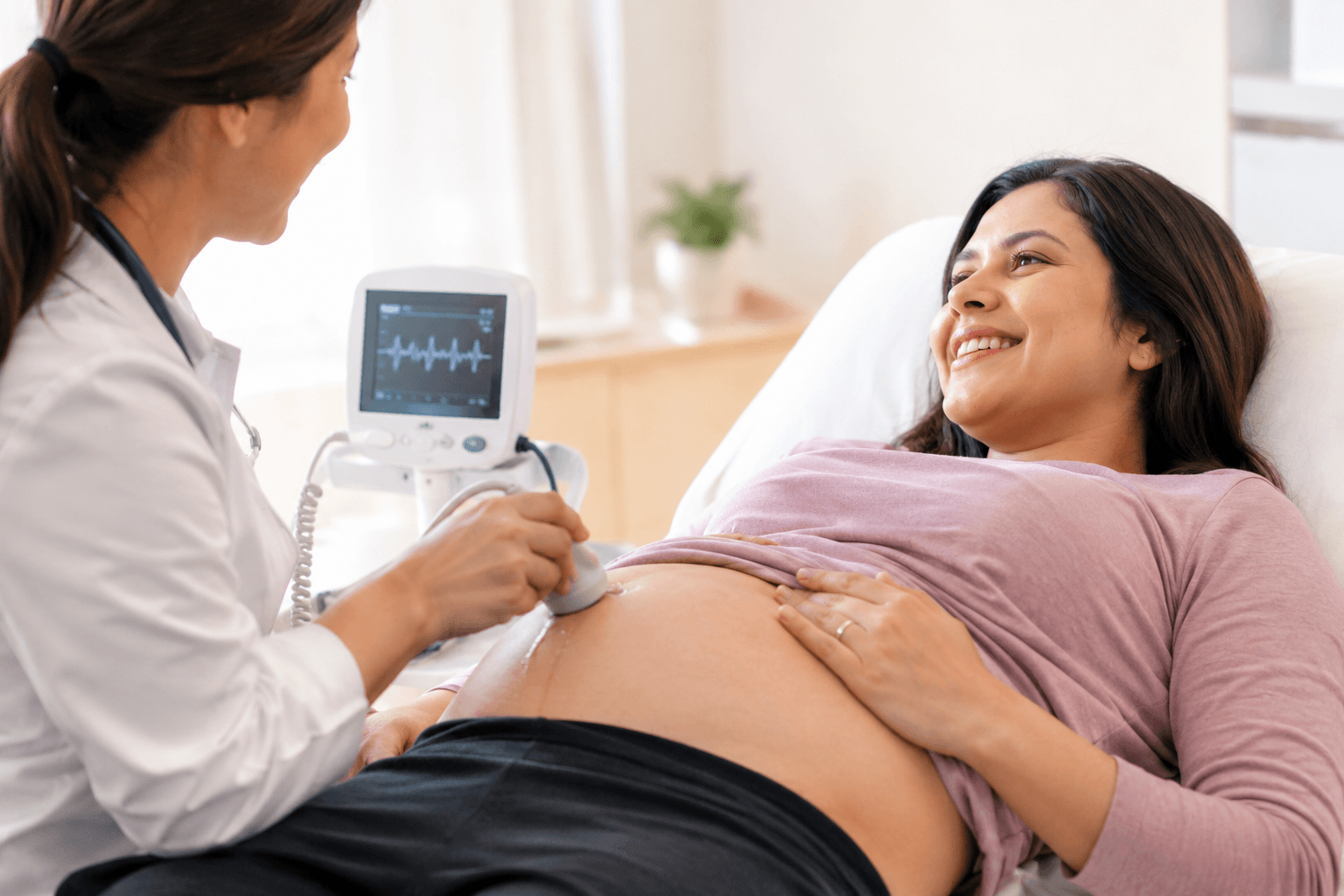
Hearing your baby's heartbeat for the first time can be one of the most memorable moments of pregnancy. For many parents, that rapid, rhythmic sound makes the pregnancy suddenly feel much more real.
But you may wonder: When can you actually hear your baby's heartbeat? The answer depends on how the heartbeat is being detected. An early ultrasound can detect cardiac activity much sooner than a handheld Doppler can reliably pick up a heartbeat through the abdomen.
It is also important to understand that pregnancy develops at different rates, and not hearing a heartbeat at a very early appointment does not automatically mean that something is wrong.
When Does a Baby's Heartbeat Begin?
The baby's heart begins developing very early in pregnancy. Cardiac activity can often be detected by ultrasound during the early weeks of pregnancy, with NHS guidance noting that the baby's heart is first detectable around 5 to 6 weeks.
At this stage, the embryo is extremely small. Whether cardiac activity can be seen depends on factors such as the exact stage of pregnancy, the type of ultrasound being used, and how accurately the pregnancy has been dated.
This is one reason early pregnancy appointments can sometimes involve more uncertainty than expectant parents anticipate.
When Can an Ultrasound Detect the Heartbeat?
An early pregnancy ultrasound, particularly a transvaginal ultrasound, can detect cardiac activity during the early weeks of pregnancy.
At approximately 5 to 6 weeks, cardiac activity may be visible on an ultrasound. However, the exact timing varies, and pregnancy dating is not always precise.
An ultrasound does not necessarily mean that you will hear a heartbeat as a sound. During an early scan, the Health Care Provider may be looking at the developing embryo and observing cardiac activity on the screen.
As pregnancy progresses, the heartbeat becomes easier to detect.
When Can You Hear the Heartbeat With a Doppler?
A handheld fetal Doppler is different from an early ultrasound.
A Doppler is placed against the abdomen and uses ultrasound technology to detect fetal heart sounds. However, because the baby is very small during early pregnancy, it may be difficult to locate the heartbeat.
Some maternity services begin listening with a handheld Doppler from around 16 weeks. St George's University Hospitals notes that a handheld Doppler or Pinard stethoscope can be used from 16 weeks onward, while also explaining that finding the heartbeat can take longer when the baby is still small.
Therefore, if you have an appointment at 10 or 12 weeks and a Doppler cannot find the heartbeat, that alone does not necessarily indicate a problem.
The timing and method used should be discussed with your maternity care team.
Why Might the Heartbeat Be Difficult to Find?
There are several reasons why a fetal heartbeat may be difficult to detect with a handheld Doppler.
These can include:
- It is still early in pregnancy
- The baby is very small
- The baby's position makes detection difficult
- The uterus is positioned differently
- The placenta is located toward the front of the uterus
- Pregnancy dates may be slightly different from the estimated dates
- The Doppler needs to be positioned carefully
At early gestational ages, even a trained Health Care Provider may need additional time to locate the heartbeat.
This is why the absence of an audible heartbeat with a Doppler should not automatically be interpreted as an indication that something is wrong.
What Is the Difference Between Ultrasound and Doppler?
Understanding the difference can make pregnancy appointments less confusing.
Ultrasound
An ultrasound uses sound waves to create images of the pregnancy. It can allow a Health Care Provider to observe the developing baby and assess pregnancy development.
Early ultrasound may be performed using a transvaginal probe because the uterus and embryo are still very small.
Handheld Doppler
A Doppler is primarily used to detect and listen to fetal heart sounds. It is generally more useful later in pregnancy when the baby is large enough for the heartbeat to be detected more easily through the abdomen.
The two technologies have different purposes, and neither should be used to replace appropriate prenatal assessment.
What Does a Normal Fetal Heartbeat Sound Like?
A fetal heartbeat is typically much faster than an adult's resting heartbeat.
The rate changes throughout pregnancy. NHS guidance notes that it may be around 110 beats per minute around weeks 5 to 6, rising to approximately 170 beats per minute around weeks 9 to 10 before gradually slowing later in pregnancy.
Parents often describe the sound as a quick, rhythmic "whooshing" or galloping noise.
However, the sound heard through a Doppler is not something parents should try to interpret on their own. A Health Care Provider considers the heart rate together with gestational age, pregnancy history, symptoms, fetal movement, and other clinical information.
What If You Cannot Hear the Heartbeat Yet?
If a heartbeat cannot be detected during an early appointment, try not to immediately assume the worst.
The next step depends on how far along you are and what method was used to look for the heartbeat.
Your Health Care Provider may recommend:
- Waiting and repeating an ultrasound
- Checking pregnancy dates
- Performing another type of assessment
- Monitoring symptoms
- Conducting additional prenatal evaluation when appropriate
Sometimes the pregnancy is simply earlier than expected.
If your pregnancy is very early, a repeat assessment after some time may provide much clearer information than trying to detect the heartbeat immediately.
Can You Use a Home Doppler?
Home fetal Dopplers may seem appealing because they allow parents to listen to the heartbeat between appointments. However, they are not recommended as a way to check whether your baby is well.
The NHS specifically advises against using home Dopplers to assess fetal wellbeing. Even if you hear a heartbeat, that does not confirm that the baby is healthy.
There is also a risk of confusing the mother's heartbeat or blood flow through the placenta with the baby's heartbeat.
If you are worried about your pregnancy, speaking with your maternity care team is much safer than relying on a home device.
A Heartbeat Is Only One Part of Prenatal Care
Hearing your baby's heartbeat can be reassuring, but it is only one component of pregnancy care.
Prenatal appointments may also include monitoring your health, checking pregnancy development, discussing nutrition and lifestyle, assessing symptoms, reviewing screening options, and preparing for birth and postpartum recovery.
As pregnancy progresses, fetal movement also becomes an important part of monitoring wellbeing. NHS guidance states that most women begin feeling their baby move between 16 and 24 weeks, although timing can vary, particularly during a first pregnancy.
Later in pregnancy, a noticeable reduction or change in your baby's usual movement pattern should be reported promptly to your maternity care team.
When Should You Contact Your Health Care Provider?
Pregnancy can bring many questions, particularly when something feels different from what you expected.
Contact your Health Care Provider or maternity care team if you experience concerning symptoms or have questions about your baby's development.
In later pregnancy, seek prompt maternity assessment if your baby's movements become noticeably reduced or change from their usual pattern. Do not rely on a home Doppler for reassurance.
Your care team can determine whether you need an examination, fetal monitoring, ultrasound, or another form of assessment.
Hearing Your Baby's Heartbeat at a Birth Center
For families planning birth-center care, prenatal appointments can provide opportunities to monitor pregnancy progress, discuss birth preferences, prepare for labor, and ask questions about fetal wellbeing.
Clinique Molière in Brea, California, provides midwifery-led Birth & Postpartum Care that includes prenatal checkups, monitoring of maternal health and baby's growth, prenatal education, nutrition guidance, emotional support, personalized birth planning, labor support, and postpartum care.
The clinic's childbirth education also helps families prepare for labor, comfort measures, breastfeeding, newborn care, and the transition into parenthood.
Having a consistent care team throughout pregnancy can make it easier to understand what is happening at each stage and when additional assessment may be appropriate.
A Special Moment in Your Pregnancy Journey
Hearing your baby's heartbeat can be an emotional milestone, but remember that there is no single appointment when every pregnancy must produce an audible heartbeat. Cardiac activity may be detectable on ultrasound around 5 to 6 weeks, while a handheld Doppler is generally easier to use later in pregnancy, often from around 16 weeks.
If you cannot hear the heartbeat when you expected to, give yourself permission to pause before assuming something is wrong. Your pregnancy may simply be earlier than estimated, or the heartbeat may be difficult to locate with the method being used. A trained Health Care Provider can evaluate the pregnancy and explain what the findings mean for you. If you are preparing for pregnancy, currently expecting, or simply want knowledgeable support throughout your journey, connect with a trusted Holistic Care Provider or Health Care Provider who can provide personalized prenatal care and answer your questions with compassion. Clinique Molière, Brea, CA | (714) 948-5655 — your pregnancy deserves thoughtful care, clear information, and support at every stage.