
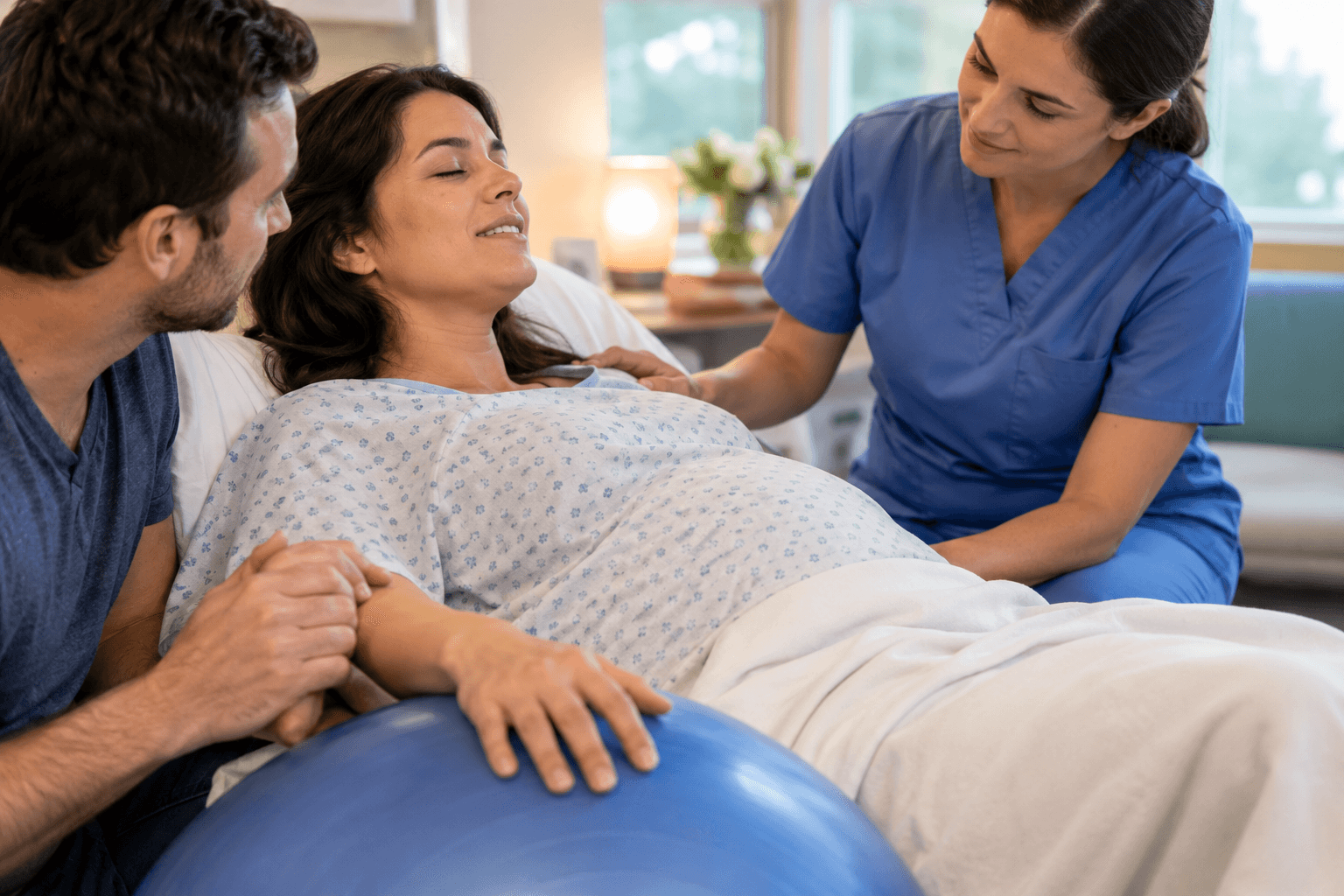
Labor and delivery are deeply personal experiences, and every birthing person responds to labor pain differently. Some prefer to begin with natural comfort measures, while others choose medical pain relief or a combination of approaches. There is no single correct way to manage labor pain. The goal is to help you feel informed, supported, safe, and comfortable with the decisions you make.
Understanding your options before labor begins can reduce uncertainty and help you communicate your preferences to your maternity care team. Evidence-based approaches include continuous labor support, breathing and relaxation, massage and movement, water immersion, and medical pain relief. These techniques can be used individually or combined according to your needs and clinical circumstances. The American College of Obstetricians and Gynecologists (ACOG) recognizes both medication-based and nonmedication approaches to labor pain management.
1. Continuous Labor Support From a Trusted Person
Having a supportive person with you throughout labor can make a meaningful difference in your birth experience. This person might be your partner, a family member, a trained doula, or another trusted support person. Their role is to offer reassurance, help you use coping techniques, communicate your needs, and provide practical comfort.
Continuous labor support may include:
- Offering encouragement and calm reassurance during contractions.
- Helping you change positions or find a comfortable posture.
- Providing gentle massage or firm pressure on your lower back.
- Reminding you to relax your shoulders and jaw between contractions.
- Helping you understand information shared by your maternity care team.
- Supporting your informed choices and helping communicate your preferences.
Research summarized in ACOG guidance suggests that continuous support during labor is associated with a greater likelihood of spontaneous vaginal birth, less use of pain medication, and more positive perceptions of the birth experience. However, support does not guarantee a particular outcome, and every labor is different.
A doula or monitrice may provide additional emotional and physical support, depending on their training and the services offered. Discuss their role with your maternity care team in advance so everyone understands how they can work together.
2. Breathing, Relaxation, and Mindful Coping
Breathing and relaxation techniques can help you respond to contractions with greater focus and reduce the tension that may build when you feel anxious or overwhelmed. These techniques do not necessarily eliminate pain, but they may help you cope with its intensity and maintain a sense of control.
Useful approaches include:
Slow breathing: Breathe gently and steadily, allowing your abdomen to expand comfortably as you inhale. Exhale slowly without forcing your breath.
Progressive relaxation: Notice areas where you are holding tension, such as your hands, shoulders, forehead, and jaw. Consciously soften these muscles when possible.
Visualization: Imagine a peaceful place or picture each contraction as a wave that gradually rises, reaches its peak, and then recedes.
Mindfulness: Focus on the present moment rather than anticipating every contraction that follows. Return your attention to your breathing, your support person, or a comforting sound.
Prenatal classes can provide an opportunity to practise these techniques before labor begins. You may also find it helpful to prepare a playlist, practise guided relaxation, or develop a few simple phrases that encourage you during difficult moments.
Evidence for individual relaxation methods varies, and these techniques are not guaranteed to provide sufficient pain relief for everyone. ACOG includes breathing, relaxation, and visualization among the nonmedical approaches that may help during childbirth. They can also be combined with medication when needed.
3. Massage, Counter-Pressure, and Comfortable Movement
Massage and movement offer practical ways to respond to changing sensations during labor. Rather than remaining in one position, you may find it helpful to experiment with standing, walking, rocking, leaning forward, kneeling, or resting on your side, as appropriate for your circumstances.
Massage can be particularly comforting when tension develops in the lower back, hips, shoulders, or legs. A support person may use gentle strokes, while firm counter-pressure against the lower back may help some people manage intense pressure during contractions.
Other techniques include:
- Rocking your hips while standing or sitting on a birth ball.
- Leaning over a bed, sturdy surface, or support person.
- Using pillows to support your knees, hips, or back.
- Trying hands-and-knees positioning when comfortable and appropriate.
- Applying a warm or cool compress to an area of discomfort, if permitted.
Movement and position changes can help you discover what feels most comfortable at different stages of labor. There is no need to force a position that feels uncomfortable. Your preferred position may change as contractions become stronger or your baby moves lower.
ACOG guidance recognizes massage, comfortable positions, and mobility as potential supportive measures during labor. Research on individual techniques varies, so it is best to view them as options that may improve comfort rather than methods that reliably remove pain.
Ask your maternity care team which positions are suitable for you, particularly if you have monitoring equipment, an epidural, mobility limitations, or other medical considerations.
4. Water Immersion and Warm Water for Comfort
Warm water may help you relax, reduce muscle tension, and feel more comfortable during contractions. Depending on the setting and your care plan, this might involve taking a warm shower or using a laboring tub.
Water immersion during the first stage of labor has been associated with lower reported pain scores in some studies. ACOG notes that water immersion may be beneficial for appropriately selected individuals during early labor, although evidence for different outcomes and techniques is not equally strong.
Potential comfort measures include:
- Letting warm shower water flow over your lower back.
- Sitting or standing in a comfortable position under the shower.
- Using a birthing tub if it is available and approved by your maternity care team.
- Combining warm water with slow breathing and support from a trusted person.
Water temperature, cleanliness, monitoring requirements, and your medical circumstances all matter. The care team should confirm whether immersion is appropriate and explain how it will be monitored.
Laboring in water and giving birth underwater are not the same thing. The safety requirements and evidence differ, so ask about the facility's specific policies if you are considering water birth. Water immersion may not be appropriate in every pregnancy or at every stage of labor.
5. Medical Pain Relief: Epidurals and Other Options
Evidence-based labor pain management also includes medication. Choosing medical pain relief is a valid option, and using it does not mean you have failed to prepare or have had a less meaningful birth experience.
Available options depend on the birth setting, your health, the stage of labor, and the services offered.
Epidural and spinal techniques
An epidural involves delivering medication through a small catheter placed in the lower back. It can provide highly effective pain relief during labor. Spinal and combined spinal–epidural techniques are other forms of regional pain relief used in appropriate circumstances.
These approaches may cause side effects, such as a drop in blood pressure, itching, or difficulty moving the legs temporarily. Your care team will explain the benefits, risks, monitoring requirements, and any factors that could affect your eligibility.
ACOG recommends that regional anesthesia be offered for pain relief during any stage of labor when appropriate. The decision should reflect your preferences and clinical situation.
Nitrous oxide and systemic medication
Some birth settings offer nitrous oxide, a gas inhaled through a mask to help reduce anxiety and make contractions easier to cope with. It does not usually eliminate pain and may cause temporary dizziness or nausea.
Systemic pain-relieving medications, including certain opioids, may also be available. They can cause drowsiness, nausea, or other side effects, and some can affect a newborn's alertness or breathing, particularly when given close to birth. Your Health Care Provider can explain which options are suitable and when they may be used.
You do not have to make an inflexible decision during pregnancy. You can begin with breathing, movement, massage, or water-based comfort measures and request medication later. You can also plan for medical pain relief from the beginning.
How to Prepare a Flexible Labor Pain Management Plan
Before your due date, discuss pain management options with your Health Care Provider or Holistic Care Provider. Ask which methods are available at your intended birth location, whether an anesthesiology team is accessible if needed, and what circumstances might change your options.
Consider including the following in your birth preferences:
- Your preferred comfort techniques and positions.
- Who you would like present to support you.
- Whether you are interested in a shower, tub, massage, or breathing techniques.
- Which medication options you would like to learn about.
- How you would like the care team to explain options and obtain your consent.
- What alternatives may be available if your labor or medical circumstances change.
Keep your plan flexible. Labor can be unpredictable, and your needs may change as it progresses. You deserve clear information, respectful communication, and appropriate pain relief without judgment.
Choosing the Approach That Works for You
The most suitable labor pain management strategy is the one that fits your preferences, medical needs, and circumstances at the time of birth. Continuous support, relaxation, massage, movement, and water immersion may provide comfort, while medical pain relief can offer additional or more substantial relief when desired. Combining approaches can be helpful, and you are allowed to change your mind.
If you are preparing for childbirth and would like guidance on birth planning, comfort measures, and supportive maternity care, Clinique Molière in Brea, CA, offers birth and postpartum care, childbirth education, and monitrice and doula services. Contact Clinique Molière at (714) 948-5655 to learn more about available services and discuss your birth preparation needs with the care team.